
TL;DR
Most PRP systems cannot mathematically deliver their advertised concentrations. Therapeutic PRP requires platelet concentrations exceeding 1,000,000/µL — and low-platelet preparations have been shown to fail at all clinical timepoints. Only independently validated systems like Emcyte PurePRP deliver verified results: 90% recovery rate, 15–16x baseline concentration, and <1.1% hematocrit. Here is the science behind that claim.
Every PRP system on the market promises superior results. Claims of “enhanced concentration,” “maximum platelet yield,” and “industry-leading performance” fill sales sheets and product pages alike. For physicians evaluating which system to bring into their practice, the noise is significant.
But platelet concentration is not a marketing variable. It is a biological and physical measurement governed by the laws of chemistry. And when you understand those laws, a significant portion of what gets marketed as high-performance PRP fails basic scrutiny.
This is what the science actually says.
What Platelet Concentration Is Needed for Effective PRP Therapy?
Platelet Rich Plasma works because concentrated platelets release growth factors — including PDGF, TGF-beta, VEGF, and EGF — that signal tissue repair and regeneration. The operative word is concentrated. Baseline human platelet counts typically range from 150,000 to 400,000 platelets per microliter, with an average around 225,000/µL.
A 2025 meta-analysis published in The American Journal of Sports Medicine examining 18 randomized controlled trials and nearly 2,000 patients found that PRP was only effective when platelet concentrations exceeded 1,000,000 platelets per microliter. Low-platelet preparations failed to demonstrate clinically meaningful benefit in pain reduction at any timepoint. A separate 2024 systematic review of 29 RCTs in Arthroscopy confirmed this dose-response relationship, finding that injections averaging 5.5 billion total platelets produced significant clinical improvement, while injections averaging 2.3 billion showed no statistical difference from placebo.
At the same time, concentration is not the only variable. The cellular composition of the final preparation matters considerably. Red blood cell contamination introduces inflammatory mediators that can blunt outcomes. Excessive granulocytes — particularly neutrophils — introduce proteases and reactive oxygen species that create a catabolic rather than anabolic environment at the injection site. A system that concentrates platelets while also concentrating the wrong cells is not an improvement.
Why Most PRP Concentration Claims Are Mathematically Impossible
Here is where physician due diligence becomes essential.
Platelet concentration in PRP is governed by a straightforward conservation equation. The platelets present in the final preparation cannot exceed the platelets drawn from the patient. Recovery rate — the percentage of platelets successfully captured from the starting volume — is always less than 100%. Real-world systems typically achieve 60 to 90% recovery under optimal conditions. This creates a hard ceiling on what any system can claim.
Consider a system marketed as achieving 2x concentration from a 30cc blood draw with a 15cc final PRP volume. To reach 2x concentration at that output volume, you would need to capture 100% of the platelets from the starting draw. That is physically impossible. Recovery losses are inherent to any centrifugation process. The realistic concentration from a 30cc draw producing 15cc of PRP is below 2x — not at or above it.
Some manufacturers work around this constraint by using smaller final volumes, which increases concentration but reduces the total platelet dose delivered to the patient. Others simply market figures that have not been validated by independent laboratory testing.
When a vendor cannot tell you the recovery rate and the output volume behind their concentration figure, that figure should not be taken at face value.
What Does Independent Lab Testing Show About PRP System Performance?
Third-party laboratory analysis of PRP systems has produced findings that should concern any physician making a purchasing decision. Some systems marketed as PRP have been shown to produce platelet-poor plasma at 0.5x baseline concentration — a result that is not only non-therapeutic but potentially counterproductive for certain applications.
Claims of 4x, 6x, and 8x concentration are common across the category. The difference lies in whether those claims are backed by peer-reviewed validation or internal marketing data. Rigorous independent testing measures the following:
| Metric | Why It Matters | Clinical Threshold |
|---|---|---|
| Final platelet concentration (plt/µL) | Determines therapeutic efficacy | >1,000,000/µL |
| Platelet recovery rate | Validates the concentration claim | ≥60%; best-in-class ≥90% |
| Hematocrit (RBC content) | RBC contamination triggers inflammation | <2%; optimal <1.1% |
| Granulocyte/neutrophil content | Neutrophils are catabolic in joint environments | Varies by indication |
| Monocyte concentration | Relevant for immunomodulatory applications | Context-dependent |
How Does Emcyte PurePRP Perform Against Independent Testing Standards?
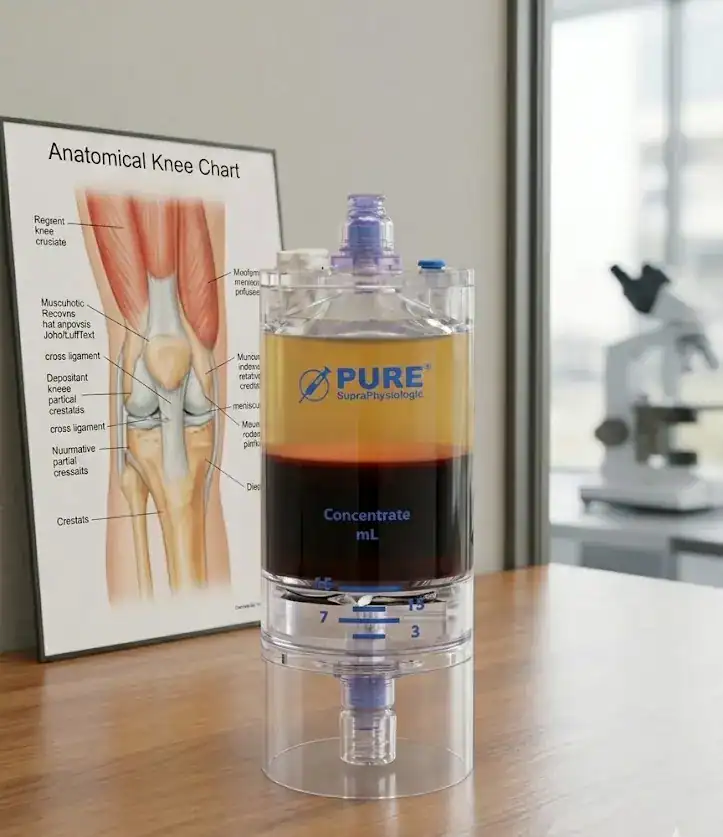
The Emcyte PurePRP system was designed around dual-spin technology specifically to address the cellular composition problem — not just the concentration problem.
Validated Performance Metrics for PurePRP (independently published):
- Up to 15–16x baseline platelet concentration
- 90% platelet recovery rate
- >99% red blood cell removal (final hematocrit below 1.1%)
- 84% reduction in granulocytes
- Selective output options: neutrophil-rich (P-PRP) or neutrophil-poor (L-PRP) depending on clinical indication
- Processing time under 15 minutes
- FDA 510(k) cleared; manufactured in ISO Class 7 cleanrooms in the United States
This matters clinically. A 2025 systematic review and meta-analysis published in Arthroscopy (Hovland et al.) found that leukocyte-poor PRP (LP-PRP) was associated with significantly reduced postoperative retear rates in arthroscopic rotator cuff repair compared to saline controls. A 2026 meta-analysis in the Journal of Shoulder and Elbow Surgery further confirmed that LP-PRP augmentation reduces structural retear risk. Emcyte PurePRP supports both LP-PRP and LR-PRP output, giving the treating physician control over the formulation.
What Questions Should Physicians Ask Before Buying a PRP System?
Before committing to a system or a distributor, four questions will tell you most of what you need to know:
- What is the validated platelet recovery rate?
Any number below 60% indicates significant platelet loss. Any vendor unable to answer this question has not done the testing. - What is the final hematocrit of the PRP preparation?
RBC contamination above 2% is clinically relevant. Below 1% is the standard to hold. - What is the granulocyte profile of the final product?
For orthopedic and musculoskeletal indications, a low-granulocyte preparation is preferable. For wound care and certain dermatological applications, a higher granulocyte load may be appropriate. Know what you are injecting. - Is the concentration figure backed by independent laboratory testing or internal data?
The distinction matters considerably.
Frequently Asked Questions About PRP Concentration
What platelet concentration is needed for therapeutic PRP?
Current evidence — including a 2025 meta-analysis in The American Journal of Sports Medicine — shows that PRP must exceed 1,000,000 platelets per microliter to produce consistent clinical benefit. Preparations below this threshold have failed to outperform placebo in controlled trials.
What is a normal platelet recovery rate for PRP systems?
Recovery rate refers to the percentage of platelets from the initial blood draw that are captured in the final PRP product. Industry averages range from 60–80%. Best-in-class systems like Emcyte PurePRP achieve approximately 90% recovery, which is what enables their high concentration figures to be mathematically consistent.
What hematocrit level is acceptable in PRP preparations?
Red blood cell contamination above 2% is clinically relevant and can blunt outcomes by introducing pro-inflammatory mediators. The clinical standard to hold is below 1%. Emcyte PurePRP achieves a final hematocrit below 1.1%.
What is the difference between leukocyte-rich (LR-PRP) and leukocyte-poor (LP-PRP)?
LR-PRP contains elevated neutrophil content. LP-PRP has neutrophils selectively removed. For intra-articular applications — orthopedics, osteoarthritis, rotator cuff repair — multiple meta-analyses favor LP-PRP because neutrophils release proteases and reactive oxygen species that are catabolic in joint environments. For wound care and certain dermatological applications, LR-PRP may be more appropriate.
Why do some PRP concentration claims fail basic physics?
Because platelet concentration is conserved — you cannot end up with more platelets than you drew from the patient. Any system claiming high concentration from a large starting volume with a large output volume has either a very low recovery rate or a marketing claim that has not been independently validated. Ask for the recovery rate and the output volume to verify any concentration claim.
Does the total platelet dose matter, not just concentration?
Yes. Emerging evidence from 2024–2025 studies suggests that total platelet dose — not just concentration — is a key efficacy driver. Research identifies a dose threshold of ≥3.5–5 billion platelets per injection, with cumulative course doses of 10–12 billion associated with optimal outcomes in joint conditions like knee OA.
The Bottom Line
The PRP market has a transparency problem. Concentration figures are reported without context, recovery rates are rarely disclosed, and cellular composition is almost never addressed in sales conversations. Physicians who accept these figures at face value risk delivering subtherapeutic treatments to patients and drawing inaccurate conclusions about the efficacy of PRP as a modality.
The science is not complicated. The math is not ambiguous. What separates a high-performance PRP system from a low-performance one is measurable, verifiable, and available to any physician who asks for it.
At NewGen Biologics, we distribute Emcyte products because they hold up to scrutiny. If you would like to review the third-party validation data, compare preparation profiles across kits, or get a no-obligation sample kit to evaluate in your practice, we are available to help.
Contact us at www.newgenbiologics.com or call directly. No minimum order. No pressure.
References
- Bensa A, et al. The American Journal of Sports Medicine. 2025. (PRP efficacy threshold: >1,000,000 plt/µL)
- Berrigan W, et al. Arthroscopy. 2024. (Platelet dose and knee OA outcomes: 5.5B vs. 2.3B platelets)
- Hovland S, et al. Arthroscopy. 2025;41(11):4762–4771. doi:10.1016/j.arthro.2025.05.015 (LP-PRP reduces rotator cuff retear risk)
- Dunivan Q, et al. Journal of Shoulder and Elbow Surgery. 2026. doi:10.1016/j.jse.2026.02.018 (LP-PRP meta-analysis)
- Mishra A, et al. Nature Scientific Reports. 2021. doi:10.1038/s41598-021-83025-2 (10 billion platelet dose in knee OA)
- Patel S, et al. PMC. 2020. doi:10.3390/ijms21207794 (PRP: New Performance Understandings and Therapeutic Considerations)